How did the ride go? Read the recap and vote on riding it again →
Just down the road from Ridgefield, on the back roads of New Canaan, sits one of the most remarkable collections of modern houses in the country: flat roofs, walls of glass and stone, built in the 1940s, ’50s and ’60s by architects who changed how Americans thought about home. On a bright November morning, fifteen of us rode past twenty-six of them on one 17-mile loop. Here’s the tour, so you can take it too.

Why New Canaan?
After World War II, five architects who had studied or taught together at Harvard, Philip Johnson, Marcel Breuer, Landis Gores, John Johansen and Eliot Noyes, all settled in this small Connecticut town. They became known as the Harvard Five. Noyes came first; Breuer chose New Canaan partly because Noyes was there. They built homes for themselves, their friends and clients, and other modern architects followed. The result is a living museum you can ride through.
Flip through the book
Every house on the route was researched for the ride and gathered into a flip book you can page through like an architecture monograph: one spread per house, with the architect, the year, the story and, where we could find a freely licensed one, a photo. It’s made for a phone in your jersey pocket, too.
Seven houses worth slowing down for
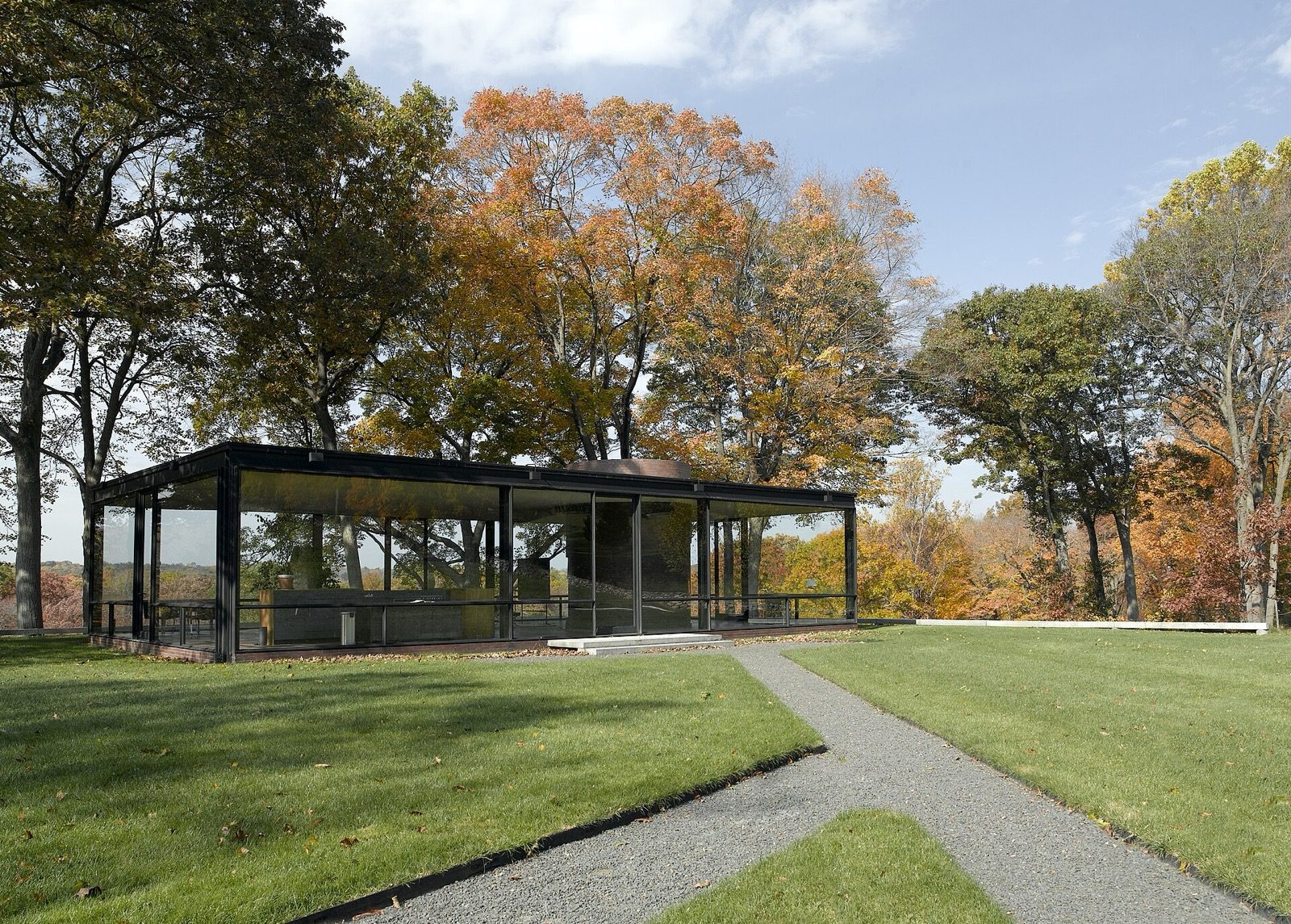
The Glass House · Philip Johnson, 1948
Johnson’s “signature work”: a glass box on a lawn, about as minimal as a house can get, with everything resting on structure, proportion, transparency and reflection. It’s a National Historic Landmark and now belongs to the National Trust for Historic Preservation. Stop 12.
Landis Gores House · Landis Gores, 1948


One of the first modern houses in New Canaan, featured in House & Home and the New York Times Magazine, and still in the Gores family. Gores himself is the tour’s great story: during World War II he was part of Ultra, the top-secret effort that broke the German high command’s codes. Years later polio left him in an iron lung, and he kept practicing architecture with the help of a special electric typewriter built by his friend John Irwin, whose pool house Gores designed at stop 1. Stop 16.
Hodgson House · Philip Johnson with Landis Gores, 1951


Johnson designed it, Gores was the associate: the two worked as a pair, Johnson sketching and Gores turning ideas into finished drawings, until they went their separate ways that same year. Stop 11, right before the Glass House.
Techbuilt / Swallen House · Carl Koch, 1954


A modern house in a kit. The whole shell, walls, floors, roof and beams, arrived on one truckload, and four men could frame and roof it in two days. Fittingly, one of our riders, Jon Swallen, grew up in one of the houses on the route and told us what it was like to build and live in one. Stop 3, ride by.
Mills House 2 · Willis N. Mills, 1956


Mills, a principal at Sherwood, Mills & Smith, built this for himself, and it won design awards from Architectural Record. Stop 13.
Lee House 1 · John Black Lee, 1952


The first of several houses Lee designed for his own family: minimalist, Bauhaus-style, and on the National Register of Historic Places since 2010. Stop 17.
Noyes House 2 · Eliot Noyes, 1954


In Noyes’s own words, “a fortress on one side and all glass on the other.” From the road you see the fortress; behind it, wall-size sheets of glass open the living room onto a courtyard. Stop 21, ride by.
More stories from the route
- Beaven Mills House (stop 4): designed by William Pedersen when he was just 18, before he’d earned his architecture degree. He went on to co-found Kohn Pedersen Fox, the firm behind skyscrapers around the world.
- Spotts House (stop 20): a movie star. It appears in Ang Lee’s 1997 film The Ice Storm.
- Celanese House (stop 24): a 1959 showcase house by Edward Durell Stone, built to show off the Celanese Corporation’s products. Executives reportedly would only consider Stone or Frank Lloyd Wright.
- Bremer House (stop 26): Eliot Noyes drew a conservative plan, thinking that’s what his friend Nina Bremer wanted. When she said it wasn’t interesting, he happily tore it up and started over.
- Breuer’s two houses (stops 14 and 25): his first floated, cantilevered over the lawn; his second was “grounded,” in fieldstone and glass around a courtyard.
Ride it yourself
The loop starts at Irwin Park on Weed Street, passes the Glass House on Ponus Ridge, climbs to Landis Gores’s house on Cross Ridge, and comes home along Oenoke Ridge and Sunset Hill: 17.4 miles, with the flip book open in your pocket. Every one of these is a private home, so please enjoy them from the road.
Open the flip book full screen · The route on Ride with GPS · Find a club ride
House photos are freely licensed and credited under each one (top photo of the Glass House: Carol M. Highsmith, public domain). The flip book credits every photo on its page. Thank you to Bill Adamsen for the research and the route.
